Quantum Key Distribution vs. Lattice Cryptography: Benchmarking 2026
Advertisements
Benchmarking 2026 secure data protocols, Quantum Key Distribution (QKD) and Lattice-Based Cryptography (LBC) represent leading contenders for post-quantum security, each offering distinct advantages in protecting sensitive information against future quantum attacks.
As we approach 2026, the discussion around securing our digital future intensifies, particularly concerning advanced threats. The critical comparison between Quantum Key Distribution vs. Lattice-Based Cryptography: Benchmarking 2026 Secure Data Protocols has become paramount for organizations and governments worldwide.
The Looming Quantum Threat and Cryptographic Evolution
The advent of quantum computing poses an unprecedented threat to current cryptographic standards. Traditional encryption methods, such as RSA and ECC, rely on mathematical problems that are computationally infeasible for classical computers to solve. However, quantum algorithms, particularly Shor's algorithm, could break these systems with relative ease, rendering vast swathes of our digital infrastructure vulnerable.
This impending paradigm shift has driven intense research and development into new cryptographic solutions. The need for robust, future-proof security protocols is no longer a theoretical exercise but an urgent practical requirement. Organizations are now actively evaluating and planning for the transition to quantum-resistant cryptography.
Understanding the Quantum Challenge
- Shor's Algorithm: A quantum algorithm capable of factoring large numbers exponentially faster than classical algorithms, directly threatening public-key cryptography like RSA.
- Grover's Algorithm: While less of an existential threat, Grover's algorithm can speed up unstructured search problems, potentially reducing the effective key length of symmetric ciphers.
- Harvest Now, Decrypt Later: Adversaries may be collecting encrypted data today, anticipating the future availability of quantum computers to decrypt it.
The cryptographic landscape is evolving rapidly, with a clear focus on proactive measures. Ignoring these threats is not an option, as the consequences of a quantum attack could be catastrophic, ranging from intellectual property theft to national security breaches. Therefore, understanding and implementing post-quantum cryptography is crucial for long-term data integrity and confidentiality.
Quantum Key Distribution (QKD): Principles and Promise
Quantum Key Distribution (QKD) leverages the fundamental principles of quantum mechanics to establish a secure cryptographic key between two parties, traditionally known as Alice and Bob. Its security is based on the laws of physics, not computational complexity, making it theoretically impervious to even quantum computer attacks.
The core idea behind QKD is that any attempt by an eavesdropper to measure or intercept the quantum state of the transmitted photons will inevitably disturb them. This disturbance is detectable by Alice and Bob, alerting them to the presence of an eavesdropper and allowing them to discard the compromised key. This 'no-cloning theorem' is the cornerstone of QKD's security.
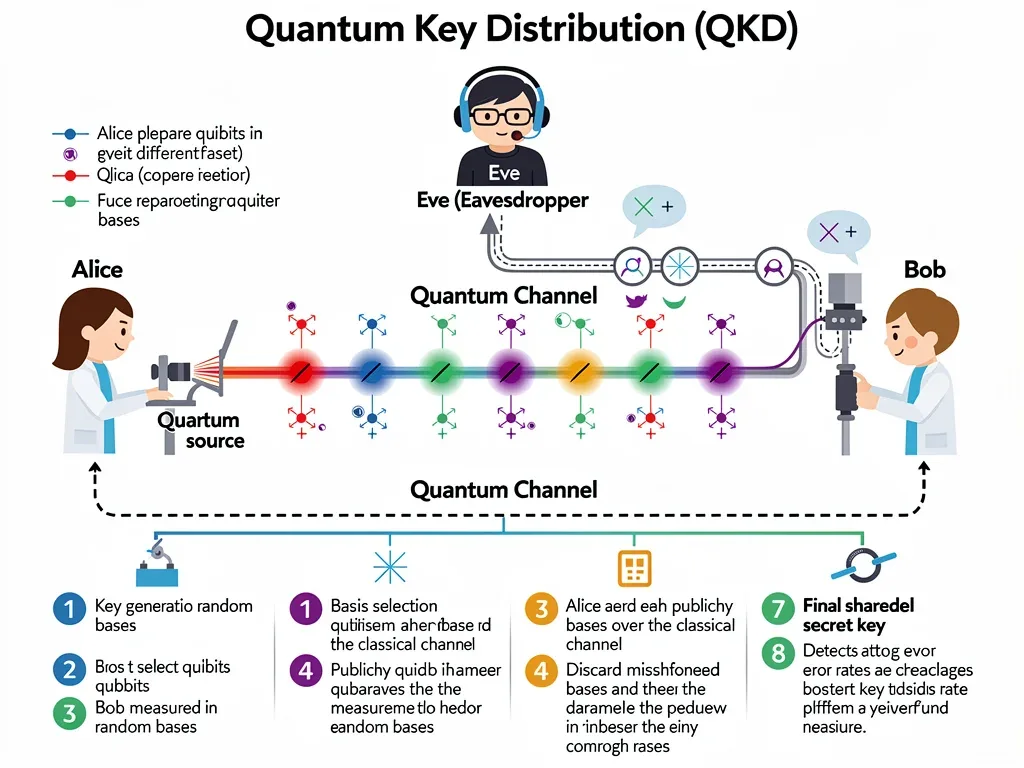
While QKD offers unparalleled theoretical security, its practical implementation faces several challenges. It typically requires specialized hardware and dedicated optical fiber links, which can be expensive and limit its range. Moreover, the secure key is established only between two points, meaning a network of QKD links is needed for broader communication.
Key Aspects of QKD Technology
- Physical Security: Relies on quantum mechanical principles for security rather than mathematical hardness.
- Eavesdropping Detection: Any attempt to intercept the key is immediately detectable.
- Limited Range: Signal attenuation in optical fibers limits the distance over which QKD can operate effectively without trusted relays.
- Hardware Intensive: Requires specialized quantum optical hardware, which can be costly and complex to deploy.
Despite these challenges, QKD continues to be a vital area of research, with ongoing efforts to improve its range, speed, and integration into existing network infrastructures. Its promise of ultimate security makes it an attractive option for highly sensitive applications.
Lattice-Based Cryptography (LBC): A Mathematical Fortress
Lattice-Based Cryptography (LBC) represents a different approach to post-quantum security, grounded in complex mathematical problems related to lattices. These problems, such as the Shortest Vector Problem (SVP) and the Closest Vector Problem (CVP), are considered intractable for both classical and quantum computers. Unlike QKD, LBC is a form of post-quantum cryptography (PQC) that relies on computational hardness, similar to current public-key cryptography, but with problems resilient to quantum algorithms.
LBC algorithms are designed to be implemented on conventional computing hardware, making them more compatible with existing infrastructure than QKD. This adaptability is a significant advantage, allowing for easier integration into current systems and protocols. Many LBC schemes have also shown promising performance characteristics, including relatively small key sizes and fast encryption/decryption operations.
Advantages of LBC
- Software Implementable: Can be implemented in software on existing hardware, reducing deployment costs and complexity.
- Versatility: Suitable for various cryptographic primitives, including encryption, digital signatures, and key exchange.
- Performance: Many LBC schemes offer competitive performance in terms of speed and key size compared to traditional cryptography.
The National Institute of Standards and Technology (NIST) has been actively standardizing post-quantum cryptographic algorithms, with several lattice-based candidates emerging as strong contenders. This standardization effort is crucial for widespread adoption and interoperability, paving the way for a secure transition to a post-quantum world.
The mathematical complexity of lattices provides a robust foundation for LBC, making it a powerful candidate for securing future data protocols. Its compatibility with current systems and strong theoretical underpinnings make it a compelling alternative to quantum-based solutions.
Benchmarking 2026: Performance and Practicality
When benchmarking QKD and LBC for 2026 secure data protocols, it is essential to consider both their theoretical security and practical implications. Both technologies offer unique strengths and weaknesses that will dictate their optimal use cases.
QKD, while offering information-theoretic security, is currently limited by distance and requires specialized optical hardware. Its deployment is often point-to-point, making large-scale network integration challenging. For example, a QKD link might secure a connection between two data centers, but extending that security across a global network requires a complex mesh of trusted nodes.
LBC, on the other hand, is a software-based solution that can be integrated into existing internet protocols (like TLS/SSL) and deployed on standard computing infrastructure. This makes it far more scalable and adaptable for general-purpose secure communication. However, its security relies on the computational hardness of mathematical problems, which, while believed to be quantum-resistant, is not information-theoretically secure like QKD.
Comparative Performance Metrics
- Key Size: LBC often has larger key sizes than current classical cryptography, but generally smaller than the quantum-generated keys of QKD.
- Throughput: LBC can achieve high data throughput, similar to classical encryption, while QKD's key generation rate can be a limiting factor.
- Latency: LBC typically introduces minimal latency, whereas QKD setup can have higher initial latency due to key establishment.
- Infrastructure: QKD requires new physical infrastructure, while LBC integrates with existing digital infrastructure.
The choice between QKD and LBC will largely depend on the specific security requirements, budget, and existing infrastructure of an organization. For ultra-sensitive, high-value data transmission over dedicated links, QKD might be preferred. For widespread, scalable, and general-purpose internet security, LBC is likely to be the more practical solution.
Hybrid Approaches: Combining Strengths
Rather than viewing Quantum Key Distribution and Lattice-Based Cryptography as mutually exclusive, a hybrid approach could offer the most robust and practical solution for 2026 secure data protocols. Combining the strengths of both technologies could provide a multi-layered defense against evolving threats.
One such hybrid model involves using QKD for establishing ultra-secure, short-range master keys, which then secure the distribution of LBC public keys or the establishment of LBC-protected communication channels. This would leverage QKD's information-theoretic security for the most critical key exchanges, while LBC handles the bulk of data encryption and general secure communication across broader networks.
Benefits of Hybrid Security
- Enhanced Security: Combines the physical security of QKD with the mathematical hardness of LBC, offering layered protection.
- Scalability: LBC can handle widespread communication, while QKD secures critical nodes or initial key exchanges.
- Flexibility: Allows organizations to tailor their security posture based on the sensitivity of data and network architecture.
- Future-Proofing: Provides a more resilient defense against unforeseen cryptographic breakthroughs.
The concept of 'quantum-safe' rather than purely 'quantum-secure' is gaining traction, acknowledging that different levels of security may be appropriate for different applications. A hybrid approach allows for a pragmatic and adaptive transition to a post-quantum cryptographic landscape, ensuring continued data protection in a world of increasingly powerful computational capabilities.
Regulatory Landscape and Standardization Efforts
The transition to post-quantum cryptography is not just a technological challenge but also a significant regulatory and standardization undertaking. Governments and international bodies are actively working to define the standards and guidelines that will govern the adoption of quantum-resistant solutions. These efforts are critical for ensuring interoperability, trust, and widespread implementation.
NIST's Post-Quantum Cryptography Standardization Process is a prime example, aiming to select and standardize algorithms that can resist quantum attacks. This process has involved extensive public review and analysis, leading to the identification of several promising candidates, many of which are lattice-based. The finalization of these standards will provide a clear roadmap for industries and agencies worldwide.
Key Regulatory Drivers
- National Security Directives: Governments are issuing mandates for federal agencies to transition to post-quantum cryptography.
- Industry Standards: Organizations like ISO and ETSI are developing standards for QKD deployment and integration.
- Compliance Requirements: Future data protection regulations may explicitly require the use of quantum-resistant encryption.
The year 2026 is often cited as a critical juncture, with many experts predicting that quantum computers capable of breaking current encryption will be more readily available. This timeline underscores the urgency of current standardization and deployment efforts. Businesses and public sector entities must stay abreast of these developments and plan their cryptographic migration strategies accordingly to avoid future vulnerabilities.
The Road Ahead: Integration and Adoption Challenges
The journey towards a fully quantum-resistant cryptographic infrastructure is fraught with challenges, extending beyond mere technological development. Integration into legacy systems, managing vast amounts of cryptographic keys, and educating the workforce are significant hurdles that organizations must overcome.
For QKD, the main challenges include the cost of deploying new fiber infrastructure or satellite links, the need for trusted relay nodes over long distances, and the integration with existing network protocols. Its use cases are likely to remain niche, focusing on critical infrastructure and highly sensitive data transmission where the highest level of security is paramount.
LBC, while more amenable to software-based deployment, still requires significant effort for integration. Organizations will need to update their cryptographic libraries, protocols, and hardware to support new algorithms. This transition will require careful planning, testing, and a phased rollout to minimize disruption and ensure compatibility across diverse systems.
Overcoming Adoption Barriers
- Legacy System Compatibility: Integrating new cryptographic primitives without disrupting existing operations.
- Key Management: Developing robust systems for managing larger and more complex post-quantum keys.
- Skilled Workforce: Training cybersecurity professionals in the intricacies of quantum-resistant cryptography.
- Cost of Transition: Budgeting for hardware upgrades, software development, and expert consultation.
Despite these complexities, the proactive adoption of quantum-resistant solutions is not an option but a necessity. The cost of inaction far outweighs the investment required for a secure transition. Organizations that begin planning and implementing their post-quantum strategies now will be best positioned to navigate the cryptographic landscape of 2026 and beyond.
| Key Protocol | Brief Description |
|---|---|
| Quantum Key Distribution (QKD) | Uses quantum mechanics for unhackable key exchange, physics-based security. |
| Lattice-Based Cryptography (LBC) | Relies on hard mathematical lattice problems, software-implementable post-quantum security. |
| Hybrid Approaches | Combines QKD's ultimate security for keys with LBC's scalability for data encryption. |
| Benchmarking 2026 | Compares practical deployment, performance, and security for future data protection. |
Frequently Asked Questions About Post-Quantum Security
What is the primary difference between QKD and LBC?▼QKD offers information-theoretic security based on quantum physics, making it theoretically unhackable. LBC provides computational security based on complex mathematical problems, designed to resist quantum computer attacks but not inherently unhackable by physics.
Why is post-quantum cryptography necessary?▼Current encryption methods are vulnerable to quantum computer attacks. Post-quantum cryptography is essential to secure sensitive data against future quantum threats, preventing potential breaches of privacy and intellectual property.
Can QKD and LBC be used together?▼Yes, hybrid approaches combining QKD and LBC are being explored. QKD could secure the distribution of LBC keys, leveraging QKD's ultimate security for critical elements and LBC's scalability for general data encryption.
What are the main challenges for QKD adoption?▼QKD faces challenges such as limited transmission range, the need for specialized hardware and dedicated fiber optic links, and difficulty integrating into existing, large-scale network infrastructures due to its point-to-point nature.
How will LBC impact current internet security protocols?▼LBC is designed to be software-implementable and compatible with existing internet protocols like TLS/SSL. Its adoption will involve updating cryptographic libraries and algorithms within current systems, aiming for a smooth transition to quantum-resistant security.
Conclusion
The journey to secure data protocols in 2026 and beyond is a complex but vital endeavor. Both Quantum Key Distribution and Lattice-Based Cryptography offer compelling solutions to the impending quantum threat, each with distinct advantages and challenges. While QKD provides information-theoretic security rooted in physics, LBC offers scalable, software-implementable security based on hard mathematical problems. The most effective path forward likely involves a pragmatic hybrid approach, leveraging the unique strengths of both technologies to create a multi-layered defense. Proactive planning, standardization, and continuous research will be crucial in navigating this cryptographic transition and ensuring the long-term integrity and confidentiality of our digital world.
