Vendor Contract Renegotiation: 5 Leverage Points to Cut Procurement Costs
Advertisements

By strategically approaching vendor contract renegotiation, businesses can unlock substantial savings, with a potential to cut procurement costs by up to 14% this quarter through careful analysis and leverage of key contractual elements.
In today's dynamic business landscape, optimizing operational costs is not merely a goal; it's a strategic imperative. One of the most impactful yet often underutilized avenues for achieving significant savings lies within your existing vendor agreements. Effective vendor contract renegotiation can unlock substantial financial efficiencies, directly impacting your bottom line. We're talking about a tangible reduction in procurement costs, potentially by as much as 14% in a single quarter, by understanding and leveraging key aspects of your contractual relationships.
Understanding the Landscape of Vendor Contracts
Before diving into the specifics of renegotiation, it's crucial to thoroughly understand the current state of your vendor contracts. This involves more than just knowing expiration dates; it's about a deep dive into terms, performance, and market relevance. A comprehensive review provides the foundation for any successful renegotiation effort.
Many organizations view contracts as static documents, signed and then filed away until renewal. This passive approach often leaves significant value on the table. Proactive management and regular review of these agreements can reveal opportunities for optimization that were not apparent at the initial signing. The market changes, your business needs evolve, and so too should your contractual agreements.
The Importance of Regular Contract Audits
Regular contract audits are not just about compliance; they are about identifying discrepancies, underperformance, and areas where terms no longer align with current market conditions or your strategic goals. Without these audits, you might be overpaying for services or products that are now available at a lower cost or with better features elsewhere.
- Identify underperforming vendors: Are you getting the value you pay for?
- Spot outdated terms: Do clauses still reflect current business realities?
- Uncover hidden costs: Are there fees or charges you weren't aware of?
- Assess market competitiveness: How do your current prices compare to market benchmarks?
By systematically auditing your vendor portfolio, you gain invaluable insights that strengthen your position at the negotiation table. This foundational work transforms renegotiation from a hopeful request into a data-driven discussion.
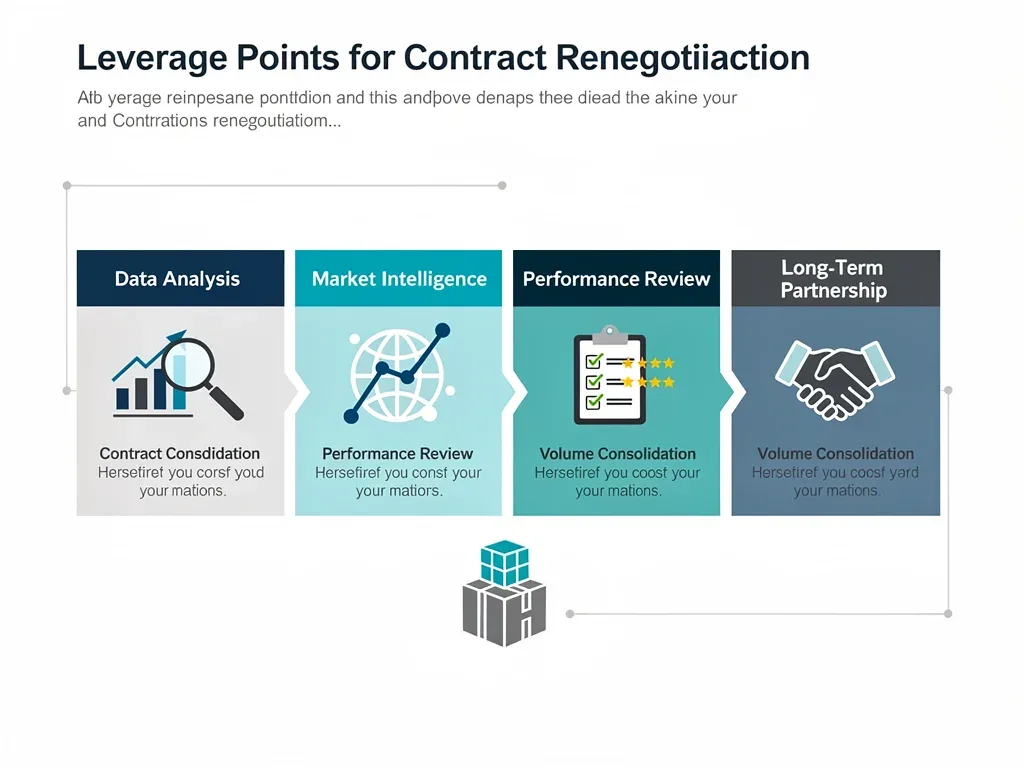
Leverage Point 1: Data-Driven Performance Analysis
The first and arguably most powerful leverage point in any vendor contract renegotiation is objective data regarding vendor performance. Numbers don't lie, and a clear, data-driven assessment of how a vendor has met—or failed to meet—their contractual obligations provides undeniable grounds for discussion. This isn't about subjective complaints; it's about quantifiable metrics.
Collecting and analyzing performance data should be an ongoing process, not something you scramble to do when a contract is up for renewal. Establish clear KPIs (Key Performance Indicators) and SLAs (Service Level Agreements) at the outset of any contract and consistently track them. This continuous monitoring ensures you have a robust dataset ready when it's time to talk about new terms.
Quantifying Vendor Value and Shortcomings
When you approach a vendor with concrete data, you shift the conversation from a general request for a discount to a focused discussion on value and accountability. For instance, if a vendor consistently delivers late, impacting your production schedule, quantifying that impact (e.g., lost revenue, increased labor costs) provides a strong case for price adjustments or improved service guarantees.
- On-time delivery rates: How often are deadlines met?
- Quality assurance metrics: What is the defect rate or service error frequency?
- Responsiveness and support: How quickly are issues resolved?
- Cost-effectiveness: Are costs escalating without proportional value?
Presenting a vendor with a detailed report of their performance, highlighting areas of excellence but also areas needing improvement, creates a collaborative environment for renegotiation. It shows you are serious about the partnership but also about getting the value you expect.
Leverage Point 2: Market Intelligence and Benchmarking
Staying informed about the broader market is a critical leverage point for successful vendor contract renegotiation. The market for goods and services is rarely static; prices fluctuate, new competitors emerge, and innovative solutions become available. Without up-to-date market intelligence, you risk negotiating in a vacuum, potentially missing out on better deals.
Market benchmarking involves comparing your current vendor's pricing, terms, and service levels against industry averages and competitors. This intelligence empowers you to approach your vendor with confidence, presenting evidence of what the market currently offers. It's not about threatening to leave, but about showing your vendor that competitive alternatives exist and that you are aware of them.
Gathering and Utilizing Market Insights
Effective market intelligence goes beyond a quick online search. It involves networking, attending industry events, subscribing to market research reports, and even issuing RFIs (Requests for Information) or RFPs (Requests for Proposal) to gauge current offerings. This proactive approach ensures you have a comprehensive understanding of the competitive landscape.
- Competitor pricing: What are similar vendors charging for comparable services?
- New technologies: Are there newer, more efficient solutions available?
- Industry trends: How are market dynamics impacting pricing and service models?
- Supplier capacity: Is there an abundance of suppliers, increasing competition?
Armed with this market data, you can articulate a compelling case for why your vendor should adjust their terms. It demonstrates that you are a savvy buyer who understands the true value of the services or products being provided, forcing the vendor to consider their own competitive positioning.
Leverage Point 3: Consolidating Volume and Strategic Partnerships
For businesses with multiple vendors providing similar services or products, consolidating volume is a potent leverage point in vendor contract renegotiation. By offering a single vendor a larger share of your business, you create an incentive for them to offer more favorable terms, including lower prices, better service, or extended payment terms. This strategy transforms scattered spending into concentrated purchasing power.
Beyond simple volume, consider fostering strategic partnerships. A strategic partner is more than just a supplier; they are an extension of your business, invested in your success. These relationships often lead to more flexible terms, preferential treatment, and a willingness to work collaboratively on cost-saving initiatives.
Maximizing Your Purchasing Power
Review your vendor spend across departments and business units. Are there instances where different teams are independently procuring the same items or services from various vendors? Consolidating these purchases under a single contract can dramatically increase your leverage. This not only simplifies vendor management but also strengthens your hand in negotiations.
- Centralize purchasing: Bring disparate purchases under one umbrella.
- Commit to longer terms: Offer extended contract durations for better rates.
- Bundle services: Combine multiple service needs with a single provider.
- Share future growth projections: Show potential for increased future business.
When a vendor sees the opportunity for increased, guaranteed revenue, they are often more willing to make concessions. This leverage point is particularly effective for larger organizations or those with significant purchasing volumes, turning fragmented spending into a strategic asset.
Leverage Point 4: Revisiting Service Level Agreements (SLAs)
Service Level Agreements (SLAs) are often overlooked during renegotiation, yet they represent a significant leverage point for optimizing costs and value. Many businesses find themselves paying for service levels they don't truly need or, conversely, suffering from inadequate service due to poorly defined or outdated SLAs. A meticulous review of these agreements can uncover substantial opportunities.
It's essential to align your SLAs with your current operational needs and strategic objectives. If your business has evolved since the original contract was signed, your service requirements likely have too. Renegotiating SLAs can lead to either reduced costs for less critical services or enhanced performance for essential ones, ensuring every dollar spent delivers maximum value.
Optimizing Service for Cost and Efficiency
Start by identifying which services are critical to your operations and which are less so. Are you paying for 24/7 support when 9-to-5 coverage is sufficient? Are response times overly aggressive for non-critical issues? Conversely, are there critical areas where current SLAs are failing to meet your business's demands, leading to internal costs or lost opportunities?
- Adjusting support hours: Align with actual business needs.
- Tiered service models: Pay only for the level of service required for each function.
- Performance penalties: Implement or strengthen clauses for non-compliance.
- Incentives for exceeding SLAs: Motivate vendors for exceptional performance.
By precisely tailoring your SLAs, you ensure that your vendor is providing exactly what you need, nothing more and nothing less. This targeted approach to service optimization directly impacts your cost structure, making it a powerful tool in vendor contract renegotiation.
Leverage Point 5: Exploring Payment Terms and Contract Duration
The final, yet often underestimated, leverage point in vendor contract renegotiation involves the financial mechanics of your agreements: payment terms and contract duration. These elements can significantly impact your cash flow and overall cost of doing business, offering fertile ground for optimization.
Extending payment terms, even by a few weeks, can provide substantial benefits to your working capital. Similarly, strategically adjusting contract durations—whether by committing to a longer term for better rates or opting for shorter terms to maintain flexibility—can yield considerable financial advantages. These are not always about reducing the sticker price, but about improving the financial conditions surrounding the agreement.
Financial Optimization Through Flexible Terms
When discussing payment terms, consider what works best for your cash flow cycle. Can you negotiate Net 60 or Net 90 terms instead of Net 30? This allows you to hold onto your cash longer, improving liquidity. For vendors, a guaranteed payment, even if delayed, can be preferable to an uncertain one, creating a win-win scenario.

- Extended payment windows: Improve your working capital.
- Early payment discounts: Capitalize on opportunities for immediate savings.
- Inflation clauses: Negotiate caps or clear adjustment mechanisms.
- Contract length strategy: Balance long-term commitment with market flexibility.
Regarding contract duration, a longer commitment can often lead to deeper discounts due to the vendor's guaranteed revenue stream. However, shorter terms might be beneficial in rapidly evolving markets where flexibility to switch providers or adopt new technologies is paramount. The key is to align duration with your strategic outlook and market conditions, making these financial adjustments a powerful lever in your renegotiation efforts.
Implementing a Strategic Renegotiation Plan
Successfully applying these leverage points requires a well-structured and strategic renegotiation plan. It's not enough to simply identify opportunities; you must systematically prepare, execute, and follow up on your renegotiation efforts. This disciplined approach ensures that you maximize your chances of achieving significant cost reductions and improving vendor relationships.
Begin by clearly defining your objectives for each renegotiation. What specific outcomes are you aiming for? What are your non-negotiables, and where are you willing to be flexible? Having a clear roadmap helps guide the conversation and prevents it from veering off course. Also, remember that renegotiation is a continuous process, not a one-time event.
Key Steps for Effective Renegotiation
A successful renegotiation plan involves several critical steps, from internal preparation to post-negotiation follow-up. Each step is designed to strengthen your position and ensure the best possible outcome for your organization.
- Internal alignment: Ensure all stakeholders (finance, operations, legal) agree on objectives.
- Data compilation: Gather all relevant performance data and market intelligence.
- Develop alternatives: Research backup vendors or alternative solutions.
- Draft proposals: Prepare clear, data-backed proposals outlining desired changes.
- Communicate clearly: Engage vendors with transparency and a focus on mutual benefit.
- Document changes: Ensure all new terms are legally documented and signed.
By following a structured approach, you can transform vendor contract renegotiation from a daunting task into a powerful strategic tool for cost reduction and enhanced operational efficiency. This proactive management of vendor relationships ultimately contributes significantly to your organization's financial health and competitive edge.
| Key Leverage Point | Brief Description |
|---|---|
| Performance Data | Utilize objective data on vendor performance to justify new terms or pricing adjustments. |
| Market Benchmarking | Compare current vendor rates and services against market averages and competitors. |
| Volume Consolidation | Aggregate purchasing power to secure better rates and more favorable contract terms. |
| SLAs & Payment Terms | Optimize service levels and payment schedules for improved cash flow and value. |
Frequently Asked Questions About Vendor Contract Renegotiation
Why is vendor contract renegotiation important for cost cutting?▼Vendor contract renegotiation is vital because it directly addresses procurement costs, which are often a significant portion of operating expenses. By optimizing terms, businesses can achieve substantial savings, improve cash flow, and ensure they are receiving the best value for their investments, directly impacting profitability.
What kind of data is most effective for renegotiating vendor contracts?▼The most effective data includes quantifiable performance metrics such as on-time delivery rates, quality control results, service response times, and comparative market pricing. This objective data provides concrete evidence to support your renegotiation requests and demonstrates areas for improvement or potential cost savings.
How can market intelligence strengthen my negotiation position?▼Market intelligence strengthens your position by providing benchmarks on what competitors offer and current industry pricing. Knowing alternative options and prevailing market rates allows you to present a compelling case for better terms, proving that your requests are reasonable and aligned with industry standards.
Is it always better to consolidate volume with fewer vendors?▼Consolidating volume can often lead to better pricing and terms due to increased purchasing power. However, it's not always ideal. Diversifying vendors can mitigate risk and maintain competitive tension. The decision depends on the specific goods or services, market conditions, and your organization's risk tolerance.
What role do Service Level Agreements (SLAs) play in cost reduction?▼SLAs are crucial for cost reduction by ensuring you only pay for the service levels you truly need. Revisiting and adjusting SLAs can eliminate overpaying for unnecessary services or, conversely, secure better performance where it matters most, preventing hidden costs from inadequate service and optimizing overall value.
Conclusion
The strategic approach to vendor contract renegotiation outlined above is more than just a cost-cutting exercise; it's a fundamental aspect of proactive business management. By diligently applying data-driven performance analysis, staying abreast of market intelligence, consolidating purchasing power, optimizing service level agreements, and shrewdly managing payment terms and contract durations, organizations can achieve significant, measurable savings. The potential to reduce procurement costs by 14% or more within a single quarter is a powerful incentive to re-evaluate existing vendor relationships. Embracing these leverage points not only boosts your financial health but also fosters more efficient, value-driven partnerships, positioning your business for sustained success in a competitive environment.
