Fractional Executive Leadership vs. Full-Time C-Suite: Cost Analysis and Performance Benchmarks
Advertisements

Fractional executive leadership provides scaling firms with specialized expertise and strategic guidance, often at a lower cost and with greater flexibility compared to hiring traditional full-time C-suite executives, directly impacting performance and growth trajectories.
In today's rapidly evolving business landscape, scaling firms face a critical decision regarding their leadership structure: should they invest in a traditional full-time C-suite, or explore the burgeoning trend of fractional executive leadership? This choice is not merely about personnel; it's a strategic imperative that profoundly impacts cost efficiency, access to expertise, and overall performance benchmarks. Understanding the nuances between these two models is essential for companies aiming to optimize their growth trajectory and competitive edge.
The Rise of Fractional Executive Leadership
The concept of fractional executive leadership has gained significant traction, particularly among startups and scaling businesses. This model allows companies to access high-caliber executive talent on a part-time or project-specific basis, providing strategic direction without the commitment and expense of a full-time hire. It’s a flexible solution designed to meet specific, often temporary, strategic needs.
Fractional executives bring a wealth of experience from various industries and companies, offering fresh perspectives and specialized skills that might otherwise be unattainable for a growing firm. They are typically brought in to address specific challenges, lead critical initiatives, or fill temporary leadership gaps, offering an agile approach to executive-level support.
Defining Fractional Executives
A fractional executive is a seasoned professional who serves multiple companies concurrently, dedicating a portion of their time to each. This model differs fundamentally from consulting, as fractional executives often integrate more deeply into a company's operations and take on direct leadership responsibilities, albeit for a limited duration or scope.
- Part-time engagement: Works a set number of hours or days per week/month.
- Strategic focus: Concentrates on high-level strategy and implementation.
- Cost-effective: Reduces overhead compared to full-time executives.
- Diverse experience: Brings insights from multiple industry exposures.
The rise of this model reflects a broader shift in the workforce towards flexibility and specialized, on-demand expertise. Companies can now strategically deploy executive talent precisely where and when it's needed most, optimizing resources and accelerating progress.
In essence, fractional executive leadership provides a powerful tool for businesses looking to scale efficiently and effectively. It allows them to tap into top-tier talent without the traditional barriers, fostering innovation and resilience in a dynamic marketplace.
Understanding the Full-Time C-Suite Model
The traditional full-time C-suite model involves hiring executives who are permanent employees, fully dedicated to a single organization. These roles, such as CEO, CFO, COO, and CMO, are typically responsible for the long-term strategic direction, operational management, and overall performance of the company. This model has been the bedrock of corporate structure for decades, offering stability and deep institutional knowledge.
Full-time C-suite members are expected to immerse themselves completely in the company culture, build enduring relationships with internal and external stakeholders, and drive consistent, sustained growth. Their commitment is undivided, and their influence permeates every aspect of the organization, ensuring cohesive leadership and vision.
Key Characteristics of Traditional C-Suite Roles
Hiring a full-time executive involves a significant long-term investment, encompassing not just salary but also extensive benefits, equity, and often relocation packages. This investment is justified by the expectation of comprehensive engagement and unwavering dedication to the company's mission.
- Exclusive dedication: 100% commitment to one organization.
- Long-term vision: Focus on sustained growth and strategic planning over many years.
- Deep integration: Fully embedded in company culture and operations.
- Comprehensive benefits: Includes salary, bonuses, equity, and health benefits.
While the financial outlay for a full-time C-suite can be substantial, the benefits often include unparalleled institutional knowledge, consistent leadership, and a unified strategic direction. These executives become the architects of the company's future, guiding it through various market cycles and challenges with a singular focus.
The traditional C-suite model remains highly effective for established corporations and larger enterprises that require continuous, hands-on leadership and have the resources to support such comprehensive roles. It fosters a strong sense of ownership and accountability, crucial for complex organizational structures.
Cost Analysis: Fractional vs. Full-Time C-Suite
The financial implications are often the most compelling factor when comparing fractional executive leadership to a full-time C-suite. Scaling firms, in particular, must judiciously manage their resources, and the cost differential between these two models can be substantial. Understanding this analysis is crucial for making an informed strategic decision that aligns with budgetary constraints and growth objectives.
Hiring a full-time executive involves a multifaceted cost structure that extends far beyond their base salary. It includes a comprehensive package of benefits, taxes, and overheads that can significantly inflate the total expenditure. In contrast, fractional executives typically operate on a contract basis, offering a more predictable and often lower total cost.
Direct and Indirect Costs
When evaluating the financial commitment, it's essential to consider both the direct and indirect costs associated with each model. Direct costs are easily quantifiable, while indirect costs, though harder to measure, can have a profound impact on a company's financial health.
- Full-time C-suite direct costs:
- Base salary (often six to seven figures)
- Performance bonuses and incentives
- Equity or stock options
- Healthcare, dental, and vision insurance
- Retirement plans (e.g., 401k matching)
- Paid time off (vacation, sick leave, holidays)
- Payroll taxes (Social Security, Medicare, unemployment)
- Full-time C-suite indirect costs:
- Recruitment fees and relocation expenses
- Office space and equipment
- Administrative support staff
- Professional development and training
- Potential severance packages
- Opportunity cost of a mis-hire
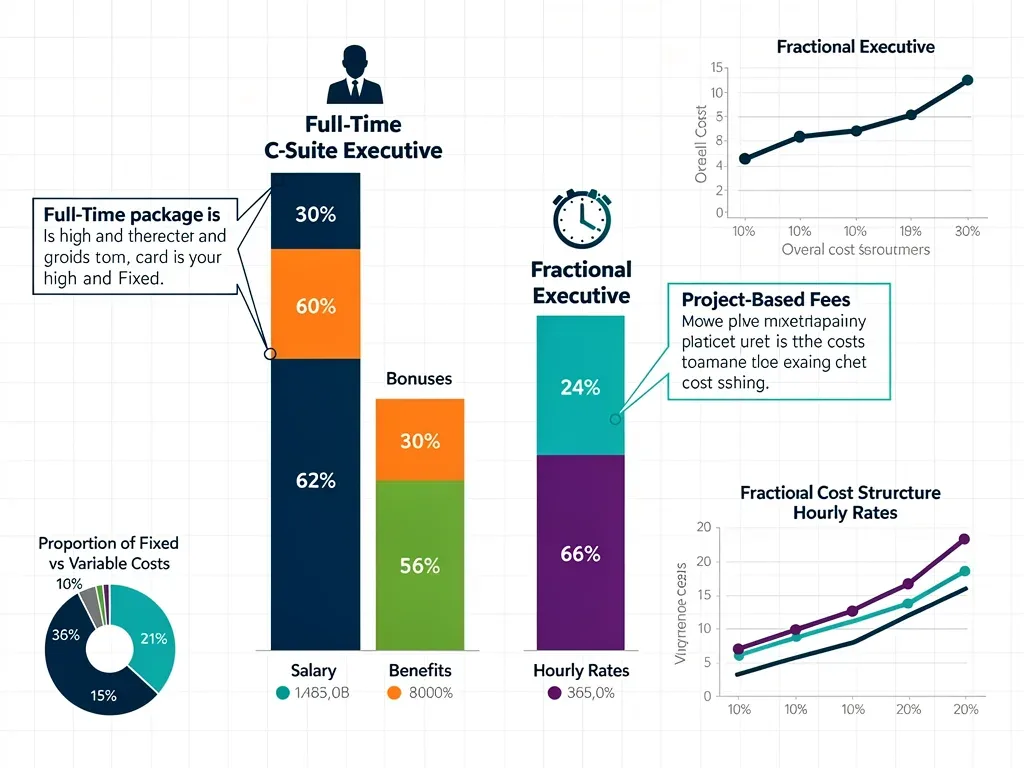
Conversely, fractional executive leadership presents a leaner financial profile. Their compensation is typically project-based, hourly, or a retainer for a specified number of hours per month. This structure eliminates many of the indirect costs associated with permanent employment.
- Fractional executive direct costs:
- Agreed-upon hourly rate or monthly retainer
- Project-based fees
- Fractional executive indirect costs:
- Minimal overhead (no benefits, taxes, office space)
- No recruitment fees for permanent placement
- Flexibility to scale up or down as needed
The cost savings from choosing a fractional executive can be substantial, often representing a fraction of the total expenditure for a full-time counterpart. This allows scaling firms to allocate capital to other critical areas of growth, such as product development, marketing, or sales, while still benefiting from top-tier strategic guidance. The ability to access high-level expertise without the long-term financial burden makes fractional executive leadership an attractive proposition for businesses with constrained budgets or specific, time-bound needs.
Performance Benchmarks: Measuring Impact and ROI
Beyond cost, the ultimate differentiator lies in performance and return on investment (ROI). Both fractional executive leadership and full-time C-suite roles aim to drive organizational success, but their impact can be measured differently based on the nature of their engagement and the strategic objectives they are tasked with achieving. Understanding these performance benchmarks is critical for evaluating which model best serves a firm's unique needs.
For scaling firms, the ability to quickly adapt, innovate, and achieve measurable results is paramount. Both executive models offer distinct advantages in this regard, and the choice often comes down to the specific goals and operational context of the business.
Evaluating Effectiveness: Fractional Executives
Fractional executives are often hired for their specialized expertise to solve specific problems or lead particular initiatives. Their performance is typically measured against pre-defined, short-to-medium-term goals, making their ROI highly trackable and often immediate.
- Agility and speed: Ability to quickly implement strategies and drive change.
- Specific project success: Achievement of defined project milestones and outcomes.
- Knowledge transfer: Imparting specialized skills and best practices to internal teams.
- Problem resolution: Effectiveness in addressing critical business challenges.
- Cost-efficiency: Achieving results within a defined budget and timeframe.
Their multi-company experience also means they can quickly identify industry best practices and common pitfalls, accelerating progress and minimizing trial-and-error. This focused approach can yield significant returns on investment for targeted strategic areas.
Evaluating Effectiveness: Full-Time C-Suite
Full-time C-suite executives are responsible for the holistic, long-term health and growth of the organization. Their performance benchmarks are broader, encompassing overall company profitability, market share, innovation, employee retention, and sustainable development. Their impact is often measured over several years.
- Sustainable growth: Consistent year-over-year revenue and profit increases.
- Strategic alignment: Ensuring all departments work towards a unified vision.
- Culture building: Fostering a positive, productive, and innovative work environment.
- Risk management: Identifying and mitigating long-term threats.
- Stakeholder relations: Building strong relationships with investors, partners, and customers.
The deep integration of a full-time executive allows for comprehensive oversight and the development of robust, long-term strategies. Their continuous presence ensures consistency in leadership and the cultivation of strong internal teams, which are vital for enduring success.

Ultimately, the choice between fractional and full-time executive leadership depends on the specific performance benchmarks a company prioritizes. If immediate, specialized impact and cost-efficiency for targeted projects are key, fractional leadership excels. If long-term, comprehensive strategic development and deep organizational integration are the goals, a full-time C-suite remains the traditional preference.
Strategic Advantages for Scaling Firms
For scaling firms, navigating the competitive landscape requires strategic agility and access to top-tier talent without overextending resources. Both fractional executive leadership and a full-time C-suite offer distinct strategic advantages, but their suitability heavily depends on the firm's stage of growth, immediate needs, and long-term aspirations. Understanding these advantages is crucial for making a leadership decision that propels growth.
Scaling firms often face unique challenges, such as rapid market changes, limited capital, and the need to quickly establish market presence. The right executive leadership can provide the necessary guidance to overcome these hurdles and capitalize on opportunities.
Fractional Executive Advantages
Fractional executives offer unparalleled flexibility and specialized expertise, making them an ideal fit for firms undergoing rapid change or requiring specific skill sets for a limited duration. Their ability to integrate quickly and deliver targeted results is a significant asset.
- Immediate expertise: Access to high-level skills without the lengthy recruitment process.
- Scalability: Easily adjust executive support based on evolving business needs.
- Reduced risk: Lower financial commitment and easier to disengage if the fit isn't right.
- Objective perspective: Brings an outsider's fresh viewpoint, free from internal politics.
- Focused impact: Concentrates on critical areas, driving rapid progress.
This model is particularly beneficial for firms looking to enter new markets, launch new products, or address specific operational inefficiencies without disrupting their core team or committing to a permanent executive hire. The strategic advantage lies in their ability to provide high-impact, targeted solutions.
Full-Time C-Suite Advantages
A full-time C-suite provides stability, deep institutional knowledge, and consistent leadership, which are invaluable for firms building a strong foundation for sustained, long-term growth. Their continuous presence fosters a cohesive culture and ensures strategic alignment across all departments.
- Deep institutional knowledge: Develops a profound understanding of the company's history, culture, and market.
- Consistent leadership: Provides stable direction and maintains strong internal relationships.
- Cultural stewardship: Instrumental in shaping and reinforcing company values and mission.
- Comprehensive oversight: Manages all aspects of the business, ensuring holistic development.
- Long-term commitment: Invested in the company's future, driving sustainable strategic initiatives.
For firms that have achieved a certain level of stability and are focused on building a lasting legacy, the comprehensive engagement of a full-time C-suite executive is often indispensable. They are the architects of the company's enduring vision and operational excellence.
Ultimately, the strategic choice between fractional and full-time leadership depends on the firm's current stage and future aspirations. Fractional executives offer agility and targeted expertise for immediate impact, while full-time C-suite members provide the stability and comprehensive vision necessary for long-term, sustainable growth.
Challenges and Considerations for Implementation
While both fractional executive leadership and full-time C-suite models offer distinct advantages, their successful implementation is not without challenges. Scaling firms must carefully consider potential hurdles and devise strategies to mitigate them, ensuring that their chosen leadership structure effectively supports their growth objectives and integrates seamlessly into their existing operations.
The decision involves more than just cost; it requires an understanding of cultural fit, communication dynamics, and the long-term strategic implications for the organization. Addressing these considerations upfront can prevent future disruptions and maximize the value derived from executive talent.
Challenges with Fractional Executives
Despite their flexibility and cost-effectiveness, bringing in fractional executives can present unique challenges, particularly concerning integration and long-term commitment. Managing multiple fractional roles across different companies requires strong organizational skills from the executive and clear communication from the hiring firm.
- Limited availability: May not be fully available during critical, urgent situations.
- Integration challenges: Difficulty in fully immersing in company culture due to part-time nature.
- Potential for misalignment: Risk of strategic divergence if not properly managed.
- Knowledge retention: Ensuring continuity of knowledge after their engagement ends.
- Perception issues: Internal teams may view them as temporary, impacting their authority.
To overcome these, clear scope definition, regular communication, and a robust onboarding process are crucial. Firms should also consider how to effectively transition knowledge and responsibilities once the fractional executive's contract concludes, ensuring that their contributions have a lasting impact.
Challenges with Full-Time C-Suite
Hiring a full-time C-suite executive, while offering stability, comes with its own set of significant challenges, primarily related to financial commitment, recruitment, and the potential for cultural fit issues. The long-term nature of these roles demands a thorough and careful selection process.
- High financial commitment: Substantial long-term salary and benefits package.
- Recruitment difficulty: Finding the right fit can be a lengthy and expensive process.
- Cultural fit risk: A mis-hire can disrupt company culture and morale significantly.
- Slower adaptation: May be less agile in responding to rapid market changes compared to external experts.
- Entrenchment: Risk of becoming resistant to new ideas or change over time.
Mitigating these challenges involves thorough due diligence during recruitment, a clear understanding of the company's cultural values, and robust performance management systems. Ensuring that full-time executives remain adaptable and open to innovation is also vital for sustained success.
Both models require careful planning and execution. Scaling firms must weigh these challenges against the potential benefits, selecting a leadership approach that not only fits their current stage but also supports their future growth trajectory while minimizing potential disruptions.
Future Outlook: Hybrid Models and Evolving Leadership
The landscape of executive leadership is continuously evolving, driven by technological advancements, changing workforce dynamics, and the increasing demand for specialized expertise. Looking ahead, the clear distinction between fractional and full-time C-suite roles is likely to blur, giving way to more sophisticated hybrid models that leverage the best of both worlds. Scaling firms, in particular, stand to benefit from these innovative approaches, optimizing both cost and performance.
The future of executive leadership will emphasize flexibility, specialized knowledge, and results-driven engagement, moving away from rigid, one-size-fits-all structures. This shift is poised to redefine how companies access and utilize top-tier talent.
Emergence of Hybrid Leadership Structures
Hybrid models combine the stability of a core full-time C-suite with the agility and specialized input of fractional executives. This approach allows firms to maintain a strong internal leadership team while strategically augmenting it with external expertise for specific projects, market expansions, or technological integrations.
- Core full-time team: Provides stability, cultural stewardship, and long-term vision.
- Fractional specialists: Brought in for targeted expertise (e.g., AI integration, market entry).
- Project-based executive roles: Temporary executive hires for specific, time-sensitive initiatives.
- Flexible engagement models: Contracts designed to adapt to fluctuating business demands.
These hybrid structures offer a powerful solution for scaling firms that need to be both stable and agile. They can build a strong internal foundation while remaining nimble enough to respond to new opportunities and challenges without incurring the full cost of additional permanent executive roles.
Technological Impact on Executive Roles
Technology, particularly AI and data analytics, is reshaping executive functions, making some tasks more efficient and creating demand for new skills. Executives, whether full-time or fractional, will increasingly rely on data-driven insights and automation to inform their decisions, leading to a more strategic and less operational focus.
- Data-driven decision making: Enhanced reliance on analytics for strategic planning.
- Automation of routine tasks: Freeing up executive time for higher-level strategy.
- Demand for digital expertise: Growing need for executives proficient in digital transformation.
- Remote leadership: Increased acceptance and effectiveness of remote executive management.
The future will see executive roles becoming more specialized and strategic, with a greater emphasis on leveraging technology for competitive advantage. This will further fuel the demand for fractional executives who can provide cutting-edge expertise in these rapidly evolving domains.
Ultimately, the future of executive leadership for scaling firms is one of adaptability and strategic resource allocation. Hybrid models, supported by technological advancements, will enable companies to build robust, agile leadership teams that can drive innovation and sustainable growth in an ever-changing business environment.
| Key Aspect | Description |
|---|---|
| Cost Efficiency | Fractional executives offer significant savings by eliminating full-time salaries, benefits, and overhead. |
| Access to Expertise | Fractional roles provide access to specialized, high-level skills on demand, crucial for scaling. |
| Flexibility & Agility | Fractional models allow firms to scale executive support up or down quickly, adapting to market changes. |
| Long-term Vision | Full-time C-suite offers deep institutional knowledge and consistent leadership for sustained growth. |
Frequently Asked Questions About Executive Leadership
What is the primary cost difference between fractional and full-time executives?▼The primary cost difference lies in total compensation. Fractional executives typically charge project-based or hourly fees, avoiding the extensive salaries, benefits, and overhead associated with full-time C-suite roles, leading to significant savings for scaling firms.
How do performance benchmarks differ for each executive model?▼Fractional executives are often measured by specific, short-term project outcomes and immediate impact. Full-time C-suite roles are benchmarked against long-term organizational growth, profitability, cultural development, and sustainable strategic execution over several years.
When should a scaling firm consider a fractional executive over a full-time hire?▼A scaling firm should consider a fractional executive when it needs specialized expertise for a specific project, requires flexible leadership without long-term commitment, or has budgetary constraints that preclude a full-time C-suite hire. It's ideal for targeted, high-impact needs.
What are the main challenges of integrating fractional executive leadership?▼Challenges include limited availability during urgent times, potential difficulties in fully integrating into company culture, ensuring smooth knowledge transfer after their departure, and managing internal perceptions of their temporary status. Clear communication and scope definition are key.
Can a hybrid executive leadership model be effective for scaling firms?▼Yes, hybrid models are increasingly effective. They combine the stability and deep institutional knowledge of a core full-time C-suite with the agility and specialized expertise of fractional executives, allowing firms to adapt and grow strategically while optimizing resources.
Conclusion
The decision between fractional executive leadership and a full-time C-suite is a pivotal strategic choice for scaling firms, one that profoundly influences both financial health and organizational performance. While the traditional full-time C-suite offers unparalleled stability, deep institutional knowledge, and long-term commitment, it comes with significant financial and integration challenges. Conversely, fractional executive leadership provides a flexible, cost-effective, and agile solution, offering specialized expertise for targeted needs and immediate impact. As the business world continues to evolve, hybrid models are emerging as a powerful compromise, allowing firms to leverage the best attributes of both approaches. Ultimately, the optimal leadership structure hinges on a firm's unique growth stage, specific strategic objectives, and its capacity to manage the inherent challenges of each model, ensuring that leadership decisions align with the path to sustainable success.
