Implementing Account-Based Marketing: B2B Growth Framework
Advertisements

Implementing account-based marketing (ABM) in B2B organizations is a strategic imperative that leverages a proven framework to drive significantly higher deal sizes, fostering greater revenue and stronger client relationships.
Are you looking to revolutionize your B2B sales and marketing efforts? Discover how implementing account-based marketing can lead to significant improvements, with organizations frequently reporting 35% higher deal sizes and enhanced customer loyalty. This article delves into a comprehensive framework designed to guide B2B companies toward ABM success.
Understanding the Core Principles of Account-Based Marketing
Account-Based Marketing (ABM) is not merely a tactic; it's a strategic approach where marketing and sales teams work in concert to target specific high-value accounts with personalized campaigns. This contrasts sharply with traditional inbound marketing, which often casts a wider net.
The fundamental shift in ABM lies in its inverted funnel approach. Instead of attracting a large volume of leads and then qualifying them, ABM begins by identifying the most valuable accounts and then crafting tailored strategies to engage them. This precision-focused method ensures that resources are concentrated on prospects most likely to convert and yield significant revenue.
Why ABM is Crucial for B2B Growth
In today's competitive B2B landscape, generic outreach often falls flat. Decision-makers are inundated with information, making personalized, relevant communication a necessity. ABM addresses this by:
- Increasing ROI: By focusing on high-value accounts, marketing spend is optimized, leading to better returns.
- Shortening Sales Cycles: Personalized content and coordinated efforts accelerate the buying journey.
- Improving Customer Lifetime Value (CLTV): Deeper engagement with key accounts fosters stronger relationships and encourages expansion.
Ultimately, ABM aligns sales and marketing around a common goal: securing and growing relationships with key accounts. This synergy is a powerful driver for sustainable B2B growth and a critical component for businesses aiming to increase deal sizes and market share.
Phase 1: Identifying and Selecting High-Value Accounts
The success of any ABM initiative hinges on the meticulous identification and selection of target accounts. This isn't a random process; it requires deep analysis and collaboration between sales and marketing to define the Ideal Customer Profile (ICP).
Begin by analyzing your existing customer base. Which clients have yielded the highest revenue? Which have the longest retention rates? What characteristics do they share? This historical data provides invaluable insights into the types of companies that derive the most value from your offerings and, consequently, are most valuable to your business.
Defining Your Ideal Customer Profile (ICP)
An ICP goes beyond basic demographics. It encompasses a comprehensive set of criteria, including:
- Firmographics: Industry, company size, revenue, geographic location.
- Technographics: Technologies used, software stack, infrastructure.
- Psychographics: Business challenges, strategic goals, pain points, company culture.
- Engagement History: Past interactions, content consumed, previous attempts at engagement.
Once the ICP is established, leverage data analytics and CRM tools to score potential accounts against these criteria. Prioritize accounts that most closely match your ICP, as these are the ones where your solution is most likely to resonate and deliver significant impact. This systematic approach ensures that the foundation of your ABM strategy is built on data-driven insights rather than assumptions.
Phase 2: Developing Personalized Content and Campaigns
With target accounts identified, the next crucial step in implementing account-based marketing is to develop highly personalized content and campaigns. This moves beyond generic messaging to address the specific needs, challenges, and goals of each target account.
Personalization at this level requires a deep understanding of the account's industry, competitive landscape, internal structure, and the individual roles of key decision-makers. Research is paramount here; delve into their company news, financial reports, social media activity, and even their employees' professional profiles to gain a holistic view.
Crafting Tailored Messaging and Offers
Each piece of content, whether an email, a landing page, a case study, or a presentation, should speak directly to the account. Consider:
- Industry-Specific Pain Points: How does your solution specifically address challenges unique to their sector?
- Role-Based Value Propositions: How does your offering benefit the CEO versus the IT manager versus the head of sales?
- Company-Specific Data: Incorporate their company name, relevant statistics, or references to their recent achievements.
Campaigns should also be multi-channel, integrating email, LinkedIn outreach, targeted ads, direct mail, and even personalized video messages. The goal is to create a cohesive and consistent experience that makes the target account feel uniquely understood and valued. This level of dedication significantly increases engagement and moves accounts further down the sales funnel.
Phase 3: Orchestrating Sales and Marketing Alignment
True success in implementing account-based marketing is impossible without seamless alignment between sales and marketing teams. This isn't just about sharing data; it's about shared goals, joint planning, and continuous communication, transforming two traditionally separate departments into a unified revenue engine.
Regular, structured meetings are essential to review target accounts, discuss progress, identify roadblocks, and refine strategies. Marketing needs to understand sales' on-the-ground insights, while sales needs to leverage the personalized content and campaign intelligence provided by marketing. This symbiotic relationship ensures that every interaction with a target account is strategic and well-informed.
Establishing Shared Metrics and KPIs
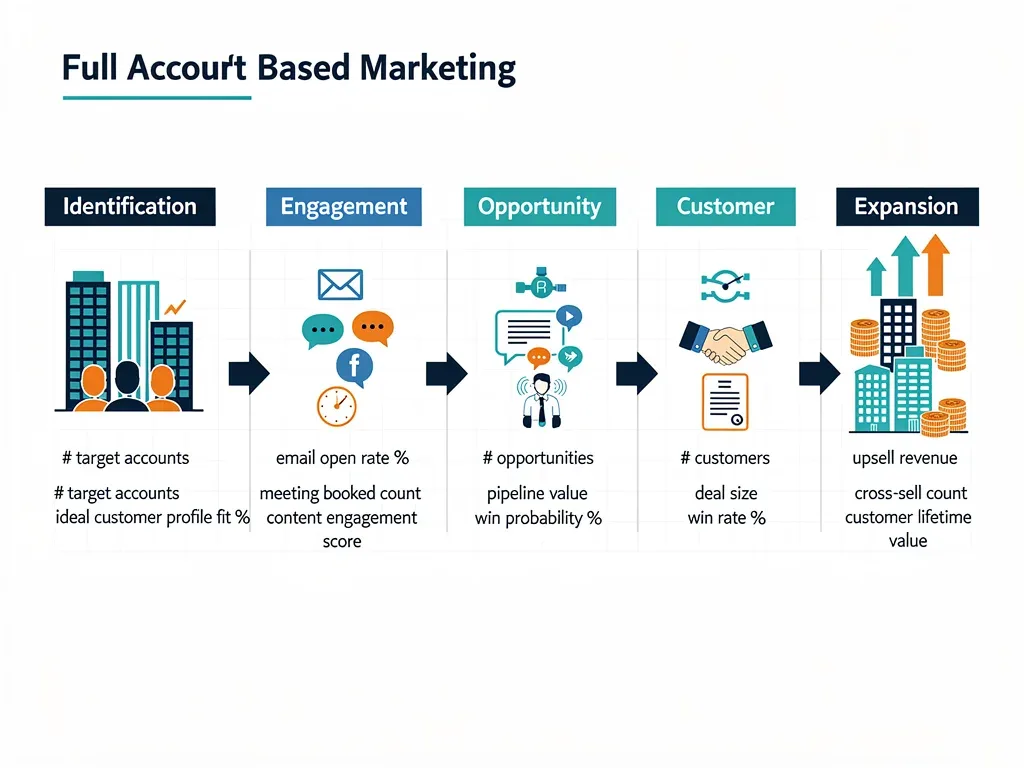
To foster alignment, both teams must operate under a common set of metrics. Instead of separate lead generation (marketing) and closed-won deals (sales) KPIs, ABM emphasizes:
- Account Engagement: Tracking interactions with target accounts across all channels.
- Pipeline Velocity: How quickly accounts move through the sales cycle.
- Deal Size and Win Rates: Direct measures of ABM's impact on revenue.
- Customer Lifetime Value: Reflecting the long-term success of retained and expanded accounts.
By focusing on these shared outcomes, both teams are motivated to collaborate, ensuring that marketing efforts directly contribute to sales objectives and sales feedback informs future marketing strategies. This integrated approach is a cornerstone of a high-performing ABM program.
Phase 4: Executing Multi-Channel Engagement Strategies
Once accounts are identified and content is prepared, the execution phase involves a coordinated multi-channel approach to engage decision-makers within target organizations. This is where the personalized narratives come to life, delivered through various touchpoints to maximize impact and reach.
Effective engagement isn't about bombarding accounts with messages; it's about delivering the right message, to the right person, at the right time, through their preferred channels. This requires a deep understanding of the buyer's journey and the specific roles of different stakeholders within the target account. Each channel should complement the others, creating a cohesive and impactful experience.

Leveraging Digital and Offline Channels
A robust ABM engagement strategy typically combines both digital and offline tactics:
- Digital: Personalized email sequences, targeted LinkedIn campaigns, custom landing pages, retargeting ads, programmatic advertising focused on specific accounts, and webinars tailored to their challenges.
- Offline: Direct mail with highly customized gifts or information, exclusive executive events, personalized outreach by sales development representatives (SDRs) and account executives (AEs), and even co-creation of content or thought leadership.
The key is to maintain a consistent brand voice and message across all channels, ensuring that the target account perceives a unified and dedicated effort from your organization. This comprehensive engagement strategy fosters trust and builds rapport, paving the way for deeper conversations and ultimately, higher deal sizes.
Phase 5: Measuring, Analyzing, and Optimizing ABM Performance
The final, continuous phase in implementing account-based marketing involves rigorous measurement, analysis, and optimization. ABM is not a set-it-and-forget-it strategy; it requires constant refinement based on performance data to ensure maximum effectiveness and ROI.
Establishing clear metrics from the outset is vital. These should go beyond traditional marketing metrics to focus on account-centric outcomes. Regularly review these metrics to understand what's working, what isn't, and where adjustments need to be made. This iterative process of learning and adapting is what drives continuous improvement and ensures the ABM framework remains agile and responsive to market changes.
Key Performance Indicators for ABM Success
Effective ABM measurement focuses on:
- Account Engagement Rate: Percentage of target accounts actively engaging with your content and outreach.
- Opportunity Creation: Number of qualified opportunities generated from target accounts.
- Average Deal Size: The financial value of closed deals from ABM efforts, compared to non-ABM initiatives.
- Sales Cycle Length: Time taken to close deals with target accounts.
- Influenced Revenue: Total revenue attributed to ABM-influenced accounts.
- Customer Retention and Expansion: Long-term success in retaining and growing revenue from these accounts.
By meticulously tracking these KPIs, organizations can gain a clear picture of their ABM program's health and impact. This data-driven approach allows for informed decision-making, enabling teams to optimize campaigns, refine account targeting, and ultimately, enhance the overall effectiveness of their ABM strategy to consistently drive higher deal sizes and sustained growth.
| Key ABM Phase | Brief Description |
|---|---|
| Account Identification | Defining ICP and selecting high-value target accounts. |
| Personalized Content | Crafting tailored messages and offers for each target account. |
| Sales & Marketing Alignment | Ensuring seamless collaboration and shared goals between teams. |
| Performance Optimization | Continuous measurement, analysis, and refinement of ABM strategies. |
Frequently Asked Questions About ABM Implementation
What is the primary benefit of account-based marketing for B2B organizations?▼The primary benefit of ABM is its ability to drive significantly higher deal sizes and improve ROI by focusing marketing and sales efforts on high-value target accounts. This precision-focused approach leads to more efficient resource allocation and stronger client relationships, ultimately boosting revenue.
How does ABM differ from traditional inbound marketing?▼ABM inverts the traditional marketing funnel by first identifying specific high-value accounts and then creating personalized campaigns to engage them. Inbound marketing, conversely, aims to attract a broad audience with general content and then qualifies leads from that larger pool.
Why is sales and marketing alignment crucial for ABM success?▼Sales and marketing alignment is critical because ABM requires both teams to collaborate closely on identifying target accounts, developing personalized strategies, and engaging prospects. Shared goals and continuous communication ensure a unified approach, maximizing the impact of every interaction.
What are some key metrics to track for ABM performance?▼Key ABM metrics include account engagement rate, opportunity creation, average deal size, sales cycle length, influenced revenue, and customer retention and expansion. These metrics provide a holistic view of the program's effectiveness and help identify areas for optimization and growth.
Can small B2B businesses effectively implement ABM?▼Yes, small B2B businesses can effectively implement ABM. In fact, ABM's focus on efficiency and targeting high-value accounts can be particularly beneficial for smaller teams with limited resources. The key is to start with a very focused list of target accounts and scale gradually.
Conclusion
Implementing account-based marketing in B2B organizations is no longer just a trend; it's a fundamental shift towards a more precise, efficient, and ultimately more profitable approach to growth. By systematically identifying high-value accounts, crafting deeply personalized engagement strategies, fostering unwavering sales and marketing alignment, and continuously optimizing performance, businesses can unlock significant advantages. The proven framework outlined here provides a clear roadmap to not only achieve but exceed ambitious revenue targets, driving an average of 35% higher deal sizes and cultivating lasting, impactful relationships with your most valuable clients. Embrace ABM to transform your B2B marketing landscape and secure a competitive edge in today's dynamic market.
