MicroLED vs. MicroOLED: Headset Display Luminance & Power
Advertisements
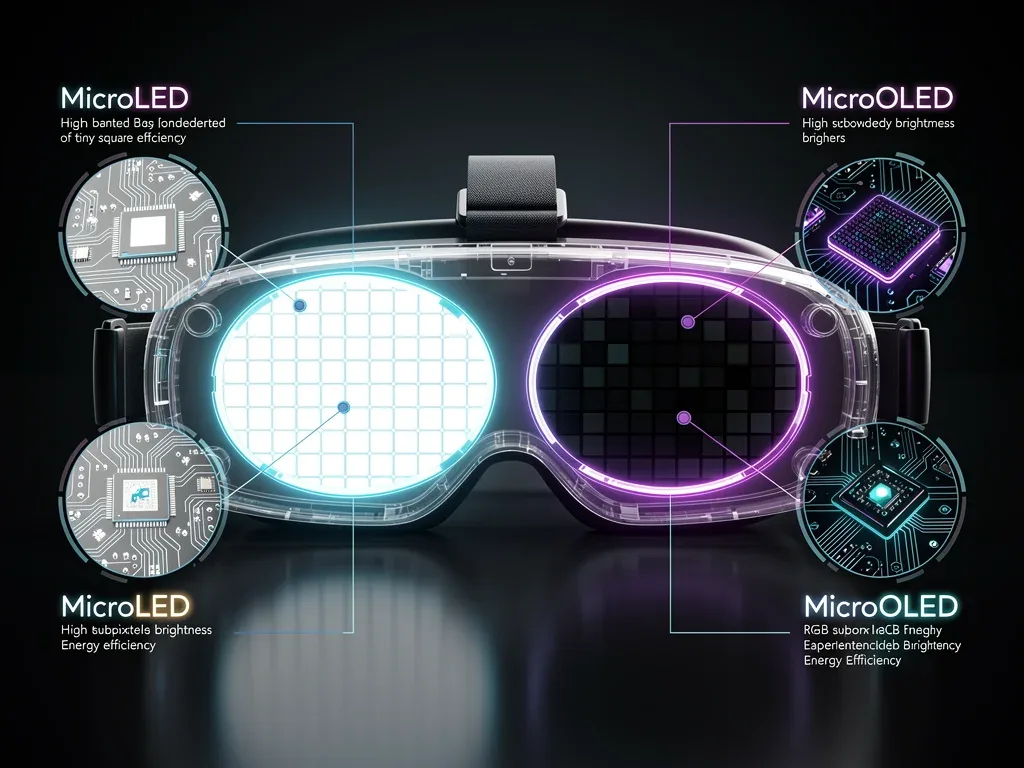
The choice between MicroLED and MicroOLED displays is pivotal for next-gen dual 4K headsets, directly influencing luminance, power consumption, and overall immersive experience.
The rapidly evolving landscape of virtual and augmented reality demands display technologies that can deliver unparalleled visual fidelity and efficiency. Central to this advancement is the critical comparison between microLED microOLED displays, particularly when considering their application in next-gen dual 4K headsets. Understanding their respective strengths in luminance and power efficiency is paramount for unlocking truly immersive and sustainable extended reality experiences.
Understanding MicroLED Display Technology
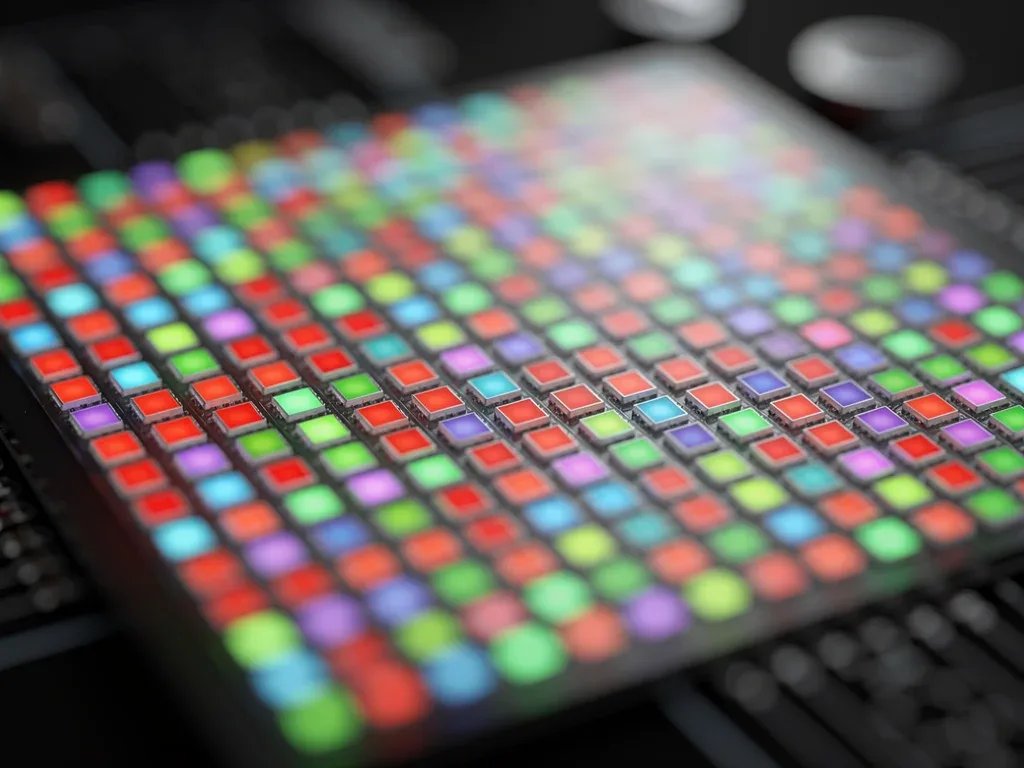
MicroLED technology represents a significant leap forward in display innovation, moving beyond traditional LED backlighting to individual, microscopic LEDs that form each pixel. This allows for self-emissive properties, similar to OLED, but with distinct advantages in brightness and longevity. The promise of MicroLED lies in its ability to deliver incredibly vibrant images and deep blacks, crucial for the demanding visual environments of VR and AR.
Unlike conventional LCDs that rely on a backlight, or even OLEDs with their organic compounds, MicroLEDs are inorganic. This fundamental difference contributes to their enhanced durability and resistance to burn-in, issues that have sometimes plagued OLED technology. The individual control over millions of microscopic light sources enables precise light modulation, leading to superior contrast ratios and dynamic range.
The Core Principles of MicroLED Operation
At its heart, MicroLED functions by using arrays of microscopic LEDs, each acting as a sub-pixel that can be individually turned on or off. This allows for true black levels and exceptional contrast. The manufacturing process involves transferring these tiny LEDs onto a backplane, a complex process that is still being refined for mass production.
- Direct Emission: Each pixel generates its own light, eliminating the need for a backlight unit.
- Inorganic Materials: Offers greater longevity and resistance to degradation compared to organic materials.
- High Brightness Potential: Capable of achieving significantly higher peak brightness levels than OLED.
- Fast Response Times: Essential for reducing motion blur in fast-paced VR/AR applications.
The development of MicroLED has been a challenging but rewarding journey. Early prototypes demonstrated immense potential, but scaling production to meet consumer demand, especially for intricate devices like dual 4K headsets, remains an engineering hurdle. However, ongoing research and investment are steadily bringing this technology closer to widespread adoption.
In conclusion, MicroLED offers a compelling vision for future displays with its robust structure, incredible brightness capabilities, and excellent contrast. These attributes position it as a strong contender for high-performance visual applications, particularly where intense light output and durability are critical.
Exploring MicroOLED Display Technology
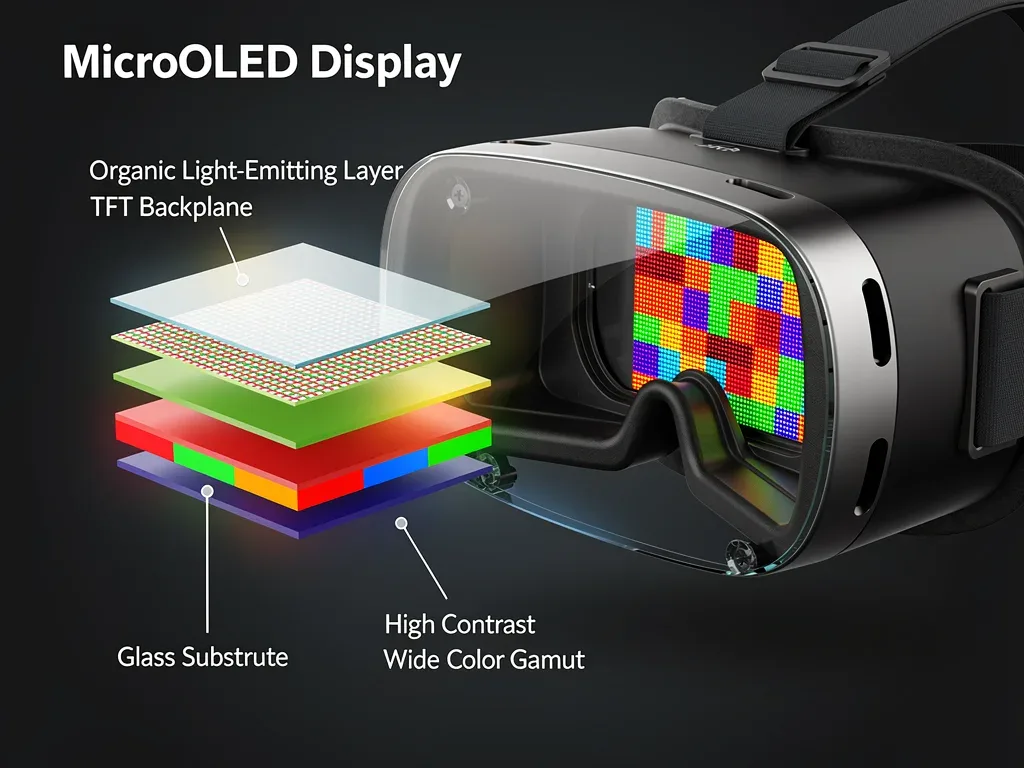
MicroOLED, or Organic Light-Emitting Diode, is another self-emissive display technology that has gained significant traction, especially in smaller form factor devices like smartwatches and, increasingly, in VR/AR headsets. Unlike traditional OLEDs, MicroOLEDs are built on silicon wafers, allowing for much higher pixel densities and smaller overall display sizes. This makes them particularly well-suited for the compact optical systems found in modern head-mounted displays.
The primary appeal of MicroOLED lies in its exceptional contrast and perfect black levels, achieved because each organic pixel can be completely turned off. This results in stunning visual depth and vibrant colors, which are crucial for creating a truly immersive virtual experience. The fast response times of OLED technology also contribute to reduced motion sickness and a smoother visual flow, important factors for user comfort in VR.
Advantages and Challenges of MicroOLED
MicroOLED displays offer several key benefits that make them attractive for next-gen headsets. Their ability to achieve very high pixel densities on a small footprint is unmatched by current MicroLED technology. This allows for incredibly sharp images without the 'screen door effect' often associated with lower-resolution VR displays.
- Exceptional Contrast: Perfect blacks and vibrant colors due to self-emissive pixels.
- High Pixel Density: Ideal for compact optical designs in VR/AR headsets.
- Fast Response Time: Minimizes motion blur and enhances user comfort.
- Thin and Lightweight: Contributes to lighter and more comfortable headset designs.
However, MicroOLED technology is not without its limitations. One of the main challenges is achieving high luminance, or brightness, particularly when compared to MicroLEDs. Organic materials can degrade over time, leading to potential burn-in issues and a shorter lifespan, especially at very high brightness levels. Power efficiency can also be a concern, as driving pixels to extreme brightness can consume significant energy, impacting battery life in portable devices.
Despite these challenges, advancements in material science and manufacturing processes are continuously improving MicroOLED performance. New organic compounds and pixel architectures are being developed to enhance brightness, extend lifespan, and improve power efficiency, solidifying MicroOLED's position as a strong contender in the advanced display market.
Measuring Luminance in Dual 4K Headsets
Luminance, often expressed in nits (candelas per square meter), is a critical metric for display performance, especially in virtual and augmented reality. In dual 4K headsets, high luminance is essential for creating realistic and vivid virtual worlds, particularly when interacting with bright virtual objects or operating in environments with significant ambient light. Without sufficient brightness, virtual content can appear dim or washed out, diminishing the sense of immersion.
The human visual system is highly sensitive to changes in brightness, and a display's ability to render a wide range of luminance levels directly impacts perceived realism. For VR and AR, where users are often completely enveloped by the display, achieving adequate brightness helps to overcome the perception of looking through a dark mask. This is where the differences between MicroLED and MicroOLED become particularly pronounced.
Techniques for Luminance Measurement
Measuring luminance accurately in a dual 4K headset is a complex task, requiring specialized equipment and methodologies. Standard display calibration tools may not be sufficient due to the unique optical paths and close proximity of the displays to the user's eyes. Specialized photometers and spectroradiometers are often employed, positioned to capture light directly from the display through the headset's lenses.
- Spot Luminance Meters: Used for precise measurements of specific areas on the display.
- Imaging Colorimeters: Provide a full-field luminance map, useful for detecting uniformity issues.
- Integrated Sphere Systems: Employed for total luminous flux measurements, crucial for overall brightness assessment.
- Human Perception Studies: Subjective evaluations complement objective measurements to understand real-world impact.
The measurement process must account for factors such as the headset's optics, stray light, and the specific viewing angle. Repeated measurements under controlled conditions are necessary to ensure accuracy and consistency. Furthermore, measuring peak luminance, sustained luminance, and luminance uniformity across the entire display surface provides a comprehensive understanding of a display's capabilities.
Ultimately, the goal of luminance measurement in dual 4K headsets is to quantify how effectively the display can deliver bright, clear, and consistent images to the user's eyes. This data is invaluable for comparing different display technologies and for optimizing the visual experience in next-gen VR/AR devices.
Analyzing Power Efficiency in Advanced Headsets
Power efficiency is a paramount concern for any portable electronic device, and next-gen dual 4K headsets are no exception. These devices often rely on internal batteries, and extended battery life is critical for user convenience and practical application. The display, being one of the most power-hungry components, plays a significant role in overall power consumption. Optimizing power efficiency directly translates to longer usage times and a better user experience.
The push for higher resolutions and brighter displays in VR/AR inherently increases power demands. A dual 4K headset, with its millions of pixels, requires substantial energy to illuminate and refresh each one. Therefore, selecting a display technology that can deliver high performance without excessive power draw is a key design consideration for manufacturers.
Factors Influencing Display Power Consumption
Several factors contribute to the power consumption of a display. The type of display technology (MicroLED vs. MicroOLED), the resolution, the refresh rate, and the overall brightness output all play a role. Higher refresh rates, while beneficial for reducing motion sickness, demand more power to update pixels faster. Similarly, increasing luminance directly increases energy expenditure.
- Pixel Type: Self-emissive displays (MicroLED, MicroOLED) consume power per active pixel.
- Resolution: More pixels mean more potential power draw.
- Refresh Rate: Higher refresh rates require faster pixel updates, increasing power.
- Brightness Level: Driving pixels to higher luminance levels requires more energy.
- Content Displayed: Darker content on self-emissive displays consumes less power than bright content.
Power management strategies are also crucial. Dynamic brightness adjustment, content-adaptive power saving modes, and efficient driver integrated circuits (ICs) can help mitigate power consumption. However, the inherent efficiency of the display technology itself forms the foundation for any further optimizations.
In summary, achieving a balance between stunning visual performance and practical battery life is a central challenge for next-gen dual 4K headsets. Display technologies that offer superior power efficiency without compromising on image quality will be highly valued in this competitive market.
MicroLED vs. MicroOLED: A Direct Comparison
When directly comparing MicroLED and MicroOLED for next-gen dual 4K headsets, several key performance indicators come into play, with luminance and power efficiency being among the most critical. Both technologies offer significant advantages over traditional LCDs, but their distinct characteristics make them suitable for different priorities in headset design.
MicroLED generally holds an advantage in terms of peak luminance. Its inorganic nature allows for much higher light output without significant degradation, making it ideal for applications that require extreme brightness, such as AR headsets that need to overlay virtual images onto real-world views in bright environments. This superior brightness also contributes to a more impactful HDR experience.
Key Differentiating Factors
While MicroLED excels in brightness, MicroOLED often leads in pixel density and manufacturing maturity for very small, high-resolution displays. The established silicon-wafer-based manufacturing process for MicroOLED allows for incredibly compact and high-PPI (pixels per inch) panels, which are essential for achieving a wide field of view without visible pixel structures in VR headsets.
- Luminance: MicroLED typically offers higher peak brightness.
- Pixel Density: MicroOLED currently achieves higher pixel densities on small substrates.
- Longevity/Burn-in: MicroLED's inorganic nature provides better resistance to burn-in and longer lifespan.
- Power Efficiency: Varies depending on content; MicroLED can be more efficient at high brightness, MicroOLED at low brightness.
- Color Accuracy: Both offer excellent color reproduction, with MicroOLED often lauded for perfect blacks.
In terms of power efficiency, the comparison is nuanced. At very high brightness levels, MicroLED tends to be more energy-efficient due to its superior light generation per watt. However, for darker content or lower brightness settings, MicroOLED can be more efficient because its pixels can be completely turned off, consuming no power. The overall power consumption in a headset will depend heavily on the typical content displayed and the desired brightness settings.
Ultimately, the choice between MicroLED and MicroOLED will depend on the specific design goals of a dual 4K headset. If extreme brightness and durability are paramount, MicroLED might be the preferred option. If ultra-high pixel density, perfect blacks, and a more mature manufacturing process for tiny displays are prioritized, MicroOLED could be the better fit. Both technologies continue to evolve rapidly, blurring some of these distinctions over time.
Future Trends and Innovations in Display Technology
The display landscape for virtual and augmented reality is far from static. Both MicroLED and MicroOLED technologies are undergoing continuous innovation, pushing the boundaries of what's possible in visual immersion. Future trends point towards even higher resolutions, increased refresh rates, and greater energy efficiency, all while striving for more compact and lightweight form factors for headsets.
One significant area of development for MicroLED is overcoming manufacturing challenges related to mass transfer and yield. Researchers are exploring new techniques to efficiently place millions of microscopic LEDs onto a substrate, which will be crucial for reducing production costs and enabling wider adoption. Improvements in driver ICs are also vital for precisely controlling these vast arrays of pixels.
Emerging Innovations to Watch
For MicroOLED, the focus is heavily on enhancing brightness and extending lifespan. New organic materials with greater luminous efficiency and stability are being developed, as well as advanced pixel structures that can withstand higher current densities without degradation. The integration of quantum dot technology with MicroOLED is also an exciting prospect, potentially boosting color gamut and brightness even further.
- Quantum Dot Integration: Enhancing color vibrancy and efficiency for both technologies.
- Transparent Displays: Crucial for advanced AR applications, allowing digital content to seamlessly blend with the real world.
- Flexible and Rollable Displays: Opening up new design possibilities for wearable tech and unconventional form factors.
- Advanced Optics: Innovations in pancake lenses and waveguides to reduce headset size and weight.
- Eye-Tracking Integration: Enabling foveated rendering for power savings and higher perceived resolution.
Beyond material and manufacturing advancements, the integration of artificial intelligence and machine learning is set to revolutionize how displays operate. AI can optimize power consumption based on user activity and content, dynamically adjust brightness for different environments, and even personalize color profiles. This intelligent display management will be key to maximizing performance and efficiency.
The convergence of these innovations promises a future where dual 4K headsets offer displays that are not only visually stunning but also incredibly efficient, durable, and seamlessly integrated into our daily lives. The ongoing competition and collaboration between MicroLED and MicroOLED will undoubtedly drive this exciting evolution forward.
Impact on Next-Gen Dual 4K Headsets
The choice between MicroLED and MicroOLED displays has profound implications for the design, performance, and user experience of next-gen dual 4K headsets. These displays are not merely components; they are the windows into virtual worlds, and their characteristics directly shape how immersive and practical a headset can be. The drive for higher resolution, wider field of view, and reduced motion sickness places immense pressure on display technology.
For VR applications, MicroOLED's current advantage in pixel density on small substrates allows for very compact optical designs, leading to lighter and less bulky headsets. This is crucial for user comfort during extended use. Its deep blacks and high contrast create a strong sense of presence, making virtual environments feel more real. However, the quest for higher brightness to overcome the perceived dimness of VR can push MicroOLED to its limits in terms of power and longevity.
Design Considerations and User Experience
In AR headsets, MicroLED's superior brightness becomes a significant differentiator. Overlaying digital information onto the real world requires displays that can compete with ambient light conditions, which MicroLED is better equipped to handle. This allows for more convincing and legible augmented content, whether indoors or outdoors. The durability of inorganic MicroLEDs also contributes to a more robust device, important for devices that may be used in various environments.
- Immersion Depth: Perfect blacks and high contrast enhance the feeling of presence.
- Visual Comfort: High resolution and fast refresh rates reduce eye strain and motion sickness.
- Battery Life: Directly impacted by display power efficiency, crucial for portability.
- Form Factor: Display size and optical requirements influence headset bulk and weight.
- Real-World Integration (AR): Display brightness and transparency are key for seamless overlays.
The power efficiency of the chosen display technology directly impacts battery life, a critical factor for untethered VR and AR experiences. A headset that can run for hours on a single charge is far more appealing than one requiring frequent recharging. Furthermore, the longevity and resistance to burn-in of MicroLEDs offer a long-term advantage, promising a more durable and reliable product for consumers.
Ultimately, the ongoing advancements in both MicroLED and MicroOLED will enable next-gen dual 4K headsets to deliver experiences that are more visually stunning, comfortable, and practical than ever before. The competition between these technologies will continue to drive innovation, benefiting users with increasingly immersive and high-performance extended reality devices.
| Key Feature | Description |
|---|---|
| Luminance | MicroLED offers higher peak brightness, crucial for AR; MicroOLED excels in contrast. |
| Power Efficiency | MicroLED more efficient at high brightness; MicroOLED efficient with dark content. |
| Pixel Density | MicroOLED currently achieves higher PPI on small substrates for VR. |
| Longevity | MicroLED's inorganic nature provides better resistance to burn-in and degradation. |
Frequently Asked Questions About Display Technologies
What is the primary advantage of MicroLED over MicroOLED for AR headsets?▼MicroLED's primary advantage for AR headsets is its significantly higher peak brightness. This allows digital content to be clearly visible and seamlessly integrated with real-world views, even in bright ambient lighting conditions, which is crucial for a convincing augmented reality experience.
How does power efficiency differ between MicroLED and MicroOLED in headsets?▼Power efficiency varies. MicroLED tends to be more efficient at very high brightness levels due to its superior light generation. MicroOLED can be more efficient when displaying dark content or at lower brightness settings because its pixels can be completely turned off, consuming no power.
Why is pixel density important for dual 4K VR headsets?▼High pixel density is crucial for dual 4K VR headsets to achieve a wide field of view without visible pixel structures, often called the "screen door effect." It ensures incredibly sharp images, enhancing immersion and reducing eye strain for the user during extended virtual reality sessions.
What are the main challenges for MicroLED widespread adoption?▼The main challenges for MicroLED widespread adoption include complex manufacturing processes, particularly the precise mass transfer of millions of microscopic LEDs onto a substrate. This complexity currently leads to high production costs and lower yields, hindering its broader commercialization for consumer devices.
Will MicroOLED displays eventually match MicroLED in brightness?▼While MicroOLED technology is continually improving, matching MicroLED's peak brightness is a significant challenge due to the inherent limitations of organic materials, which can degrade at very high luminance. However, ongoing research into new materials and pixel structures aims to significantly boost MicroOLED's brightness capabilities in the future.
Conclusion
The journey to perfecting next-gen dual 4K headsets is intrinsically linked to advancements in display technology, with MicroLED and MicroOLED standing at the forefront of innovation. Both offer compelling advantages, shaping the future of virtual and augmented reality in distinct ways. While MicroLED promises unparalleled brightness and longevity, ideal for demanding AR environments, MicroOLED excels in pixel density and contrast, creating deeply immersive VR experiences. The ongoing research and development in both fields continue to address their respective limitations, pushing the boundaries of visual fidelity and power efficiency. As these technologies mature, users can anticipate increasingly realistic, comfortable, and sustainable extended reality experiences, ultimately transforming how we interact with digital content and the world around us.
